
As an exothermic mould manufacturer in Noida, SG Power Products Pvt. Ltd. makes graphite moulds for permanent earthing and lightning protection joints. An exothermic mould holds the conductors in place while molten metal fuses them into one solid joint. Each mould is made for one joint shape and conductor size.
As a direct exothermic mould supplier, we sell exothermic moulds for earthing and lightning protection, welding powder and accessories to contractors, consultants and project buyers across India.
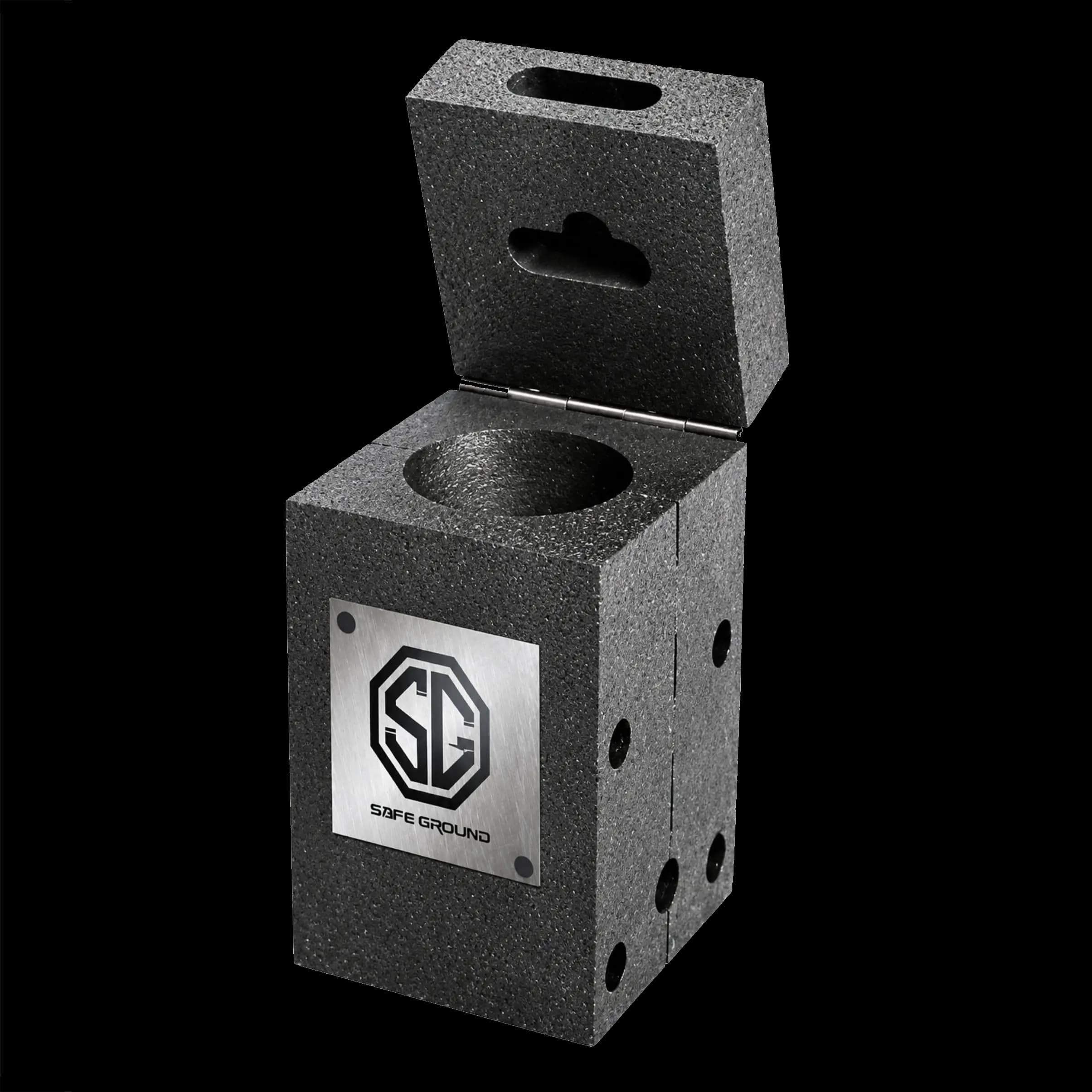
In short, an exothermic mould is a reusable graphite block with a crucible, a tap hole and a weld cavity shaped for one joint. It suits cable, earth rod, strip and busbar joints in earthing grids and lightning protection systems.
| Material | High-density, fine-grain graphite, CNC-machined |
| Joint types | Cable to cable, cable to strip, rod to cable, rod to rod, rod to strip, strip to cable, strip to strip |
| Joint shapes | Straight, T, cross, parallel and L, as per conductor layout |
| Conductors | Copper and copper bonded cable, copper and GI strip, copper bonded and copper earth rods, busbar |
| Standards | Complies with IEEE 80 and NBC 2016 (SG Power catalogue) |
| Welding powder | SG Power exothermic welding powder, matched to each mould |
| Custom moulds | Built to your drawing, conductor size and joint shape, including steel surface, pipe and rebar joints |
| Typical mould life | About 50–70 welds with proper care |
| Ignition | Flint igniter, or electronic ignition from a distance |
| Price | On request, after checking your conductor sizes and joint list |
* Prices are indicative. For the latest price, contact SG Power.
Buy your exothermic mould direct from SG Power, the manufacturer that machines each graphite mould for your conductor sizes and joint shape. You get factory pricing, help choosing the right mould and powder size, and one source for the complete earthing system.
| From SG Power (Manufacturer) | From a Trader or Reseller |
|---|---|
| Factory pricing, no middleman margin | Reseller margin added |
| Mould machined for your exact conductor sizes | Mostly stock sizes only |
| Custom moulds from your drawing | Limited to catalogue items |
| Mould, welding powder and accessories from one source | Parts often from different makers |
| Earth rods, conductors and pit covers from the same maker | Several suppliers to manage |
| Customers in 319+ cities | Depends on the reseller |
Many exothermic mould suppliers resell stock moulds, while SG Power machines each mould for your conductors and joint type.
An exothermic mould is a graphite block that holds two or more conductors and the welding powder during exothermic welding. When the powder burns, molten copper flows from the crucible into the weld cavity and fuses the conductors. The result is a permanent, low-resistance exothermic connection with a molecular bond.
It is also called an exothermic welding mould, an exothermic weld mold, a graphite mould for exothermic welding or an earthing mould. Buyers also type exothermic weld mould or commercial exothermic mould. An exothermic welding mould is not the same as the exothermic sleeves and casting moulds used in foundries, which feed molten metal into castings. American catalogues spell it exothermic mold or graphite mold. The process itself is known as exothermic welding, thermite welding or exothermic bonding.
A graphite mould for earthing is used because graphite withstands the heat of molten copper, does not stick to the weld and can be machined to tight sizes. A mould is reusable, unlike the powder, which is used once per joint.
| Mould Part | What It Does |
|---|---|
| Crucible | Holds the welding powder and contains the reaction |
| Steel disc | Sits over the tap hole and melts through, so the molten metal flows down at the right moment |
| Tap hole | Channels the molten metal from the crucible into the weld cavity |
| Weld cavity | Shapes the finished joint around the conductors |
| Conductor openings | Hold each cable, rod or strip in its exact position |
| Lid | Covers the crucible and directs the reaction gases |
| Handle clamp | Locks the two mould halves tightly, so no metal leaks out |
An exothermic mould works by holding clean, dry conductors in a closed cavity under a crucible of welding powder. The powder is ignited, and the reaction produces molten copper well above copper's 1,085°C melting point. The metal melts the steel disc, flows into the cavity and fuses the conductors.
The process takes only a few seconds once the powder is lit:
Clean and dry the conductors and the mould, and heat the mould to drive out moisture.
Place the conductors in the mould openings and lock the mould with the handle clamp.
Put the steel disc over the tap hole, then pour in the welding powder.
Sprinkle the starting (ignition) powder, close the lid and ignite it with a flint igniter.
Wait for the joint to cool slightly, open the mould and clean out the slag.
The chemistry is a thermite reaction: aluminium reduces a metal oxide, releasing intense heat and molten metal. For earthing joints, the molten metal is mostly copper, so the joint matches the conductor.
To make a joint on site, follow our step-by-step exothermic welding procedure, which covers tools, PPE, mould set-up, inspection and weld records.
Planning an earthing grid or lightning protection system? Send your joint list and conductor sizes.
Exothermic moulds are grouped by the conductors they join and the joint shape. SG Power makes moulds for cable, earth rod and strip joints, in straight, T, cross, parallel and L shapes, plus custom moulds for steel surfaces, pipes and rebar. A mould for one conductor size will not seal on another size, so each joint needs its own mould.
| Mould Type | What It Joins | Typical Use |
|---|---|---|
| Cable to cable | Two or more round conductors, straight, T, cross or parallel | Earth grid mesh, ring earth, down conductor joints |
| Cable to strip | Round conductor to flat strip | Equipment earthing tapped from a main earth strip |
| Rod to cable | Earth rod or ground rod to round conductor | Earth pit and earthing connections to the electrode |
| Rod to rod | Earth rod to earth rod | Joining rod sections for deeper electrodes |
| Rod to strip | Earth rod to flat strip | Electrode to earth strip at the pit |
| Strip to cable | Flat strip to round conductor | Busbar and strip connections in substations |
| Strip to strip | Flat strip to flat strip, straight, T or cross | Strip earth grids and equipotential bonding |
| Cable or strip to steel surface (custom) | Round conductor or strip to a steel plate, pipe or structure | Tank, pipe rack, tower and steel column earthing |
| Cable to rebar (custom) | Round conductor to steel reinforcement bar | Foundation earthing and structural bonding |
| Cable to pipe (custom) | Round conductor to a vertical or horizontal steel pipe | Pipeline, water main and structural pipe bonding |
For any other joint, SG Power designs custom exothermic moulds, made to order from your drawing.
A specific exothermic mould fits one joint shape and one set of conductor sizes, so every weld is quick and repeatable. Multi-size moulds use adapters to cover several sizes, which suits small repair jobs. For projects with many identical joints, specific moulds are faster and waste less powder.
Many exothermic mould catalogues use short codes for the conductor pair, followed by a number for the joint shape. For example, “CC” means cable to cable and “CR” means cable to rod. The table below shows common letter codes, so you can match a drawing or specification to the right mould.
| Code | Conductor Pair |
|---|---|
| CC | Cable to cable |
| CR | Cable to earth rod |
| CB | Cable to tape or busbar (strip) |
| BB | Tape to tape (strip to strip) |
| BR | Tape to earth rod |
| CS | Cable to steel surface |
| BS | Tape to steel surface |
| CRE | Cable to rebar |
The number after the letters, such as CR1 or CR2, refers to the joint shape and differs between makers. Always confirm the conductor sizes and joint shape, not just the code.
An exothermic mould is named by the two conductors it joins, their sizes, the joint shape, its position and the powder weight. For example, “25×3 mm strip to 17.2 mm rod, vertical T, 150 g” describes one specific mould. Quoting the full description avoids ordering the wrong mould.
| Part of the Mould Name | Example | What It Tells You |
|---|---|---|
| First conductor and size | 25×3 mm copper strip | The conductor in the main run |
| Second conductor and size | 17.2 mm copper bonded rod | The conductor or rod being joined |
| Joint shape | Straight, T, cross, L or parallel | The cavity shape inside the mould |
| Position | Horizontal or vertical | How the conductors sit when welded, for example a strip welded on top of a rod |
| Powder weight | For example 115 g, 150 g, 200 g or 250 g | The cartridge size the mould needs; larger joints need heavier cartridges |
Use the same description on the drawing, the purchase order and the mould label, and never change the cartridge size on site. Imported catalogues often number cartridges as #45, #90 or #115, where the number is the weld metal weight in grams.
A graphite exothermic mould is reusable for many welds, so it costs less per joint on projects with repeated joints. Single-use (one-shot) moulds are also sold; they are used once and thrown away. They suit a few joints at remote sites, where carrying and cleaning a graphite mould is not practical.
| Point | Graphite Mould (Reusable) | Single-Use Mould |
|---|---|---|
| Number of welds | Typically about 50–70 per mould | One |
| Cost per joint | Lower on projects with repeated joints | Higher, as each weld needs a new mould |
| Cleaning and preheating | Needed between welds | Not needed |
| Best for | Earth grids, substations, solar plants and other large projects | A few repair joints or remote sites |
| Joint range | Any size or shape, including custom moulds | Limited standard sizes |
SG Power makes reusable graphite moulds, which suit project work in earth grids and lightning protection systems.
The exothermic mould price in India depends on the joint type, conductor sizes, graphite grade and whether the mould is standard or custom. SG Power quotes each mould on request, after checking your conductor sizes and joint list. This way, the price matches the exact moulds your project needs.
| What Changes the Price | Why It Matters |
|---|---|
| Joint type | A straight joint needs a simpler mould than a T, cross or parallel joint |
| Conductor size | Larger cables, wider strips and thicker rods need bigger moulds and more graphite |
| Number of conductors | Joints with three or four conductors need more complex cavities |
| Graphite grade | High-density, fine-grain graphite lasts longer and gives cleaner welds |
| Standard or custom | Custom moulds made from a drawing cost more than standard sizes |
| Quantity | Project orders with many identical joints cost less per mould |
| Kit items | Welding powder, handle clamps, flint igniters and cleaning tools are priced separately |
| Item | SG Power Price (+ GST) |
|---|---|
| Standard exothermic mould (single joint type) | Price on request |
| Custom exothermic mould (as per drawing) | Price on request |
| Exothermic welding powder | Price on request |
| Handle clamps and accessories | Price on request |
* Prices are indicative. For the latest price, contact SG Power.
For a like-for-like comparison, ask every supplier to quote the joint type, conductor sizes, powder size, handle clamp and GST on each line.
To choose the right exothermic mould, match the conductor type and size, the joint shape and the welding powder size. Measure each conductor, list every joint shape on the drawing, and order one mould for each combination. The mould label should show the conductors, joint shape and powder size.
Send these details to your exothermic mould manufacturer for an accurate quote:
Conductor type: copper cable, copper bonded cable, copper strip, GI strip, earth rod or busbar
Conductor size: cross-section in sq mm for cable, width × thickness for strip, and diameter for rods
Joint shape: straight, T, cross, parallel or L, and whether the joint is horizontal or vertical
Rod or surface details: threaded or plain rod, and steel plate or structure if one side is a surface
Number of joints: total welds of each type, to plan moulds, powder and spare moulds
Site conditions: buried joints, joints above ground, or joints in a substation or tower
Not sure which mould you need? Share your earthing drawing, and we'll list the moulds and powder sizes.
To plan exothermic moulds and powder for a project, count the joints of each type and conductor size, then work out powder, moulds and accessories from that count. Use one powder cartridge per weld and one mould for about every 50 welds of the same type. Add spares, because damp or damaged cartridges and worn moulds happen on site.
List every joint: count each combination of joint shape and conductor size from the earthing drawing.
Powder: one cartridge per weld, in the size shown on the mould label, plus about 5–10% spare.
Steel discs: one per weld; they usually come with the powder.
Moulds: divide the welds of each type by 50 and round up, then add one spare mould per type.
Handle clamps: at least one clamp for each mould size in use, plus a spare on large projects.
Tools and safety items: one set for each welding team, as listed in the kit section below.
| Example: 400 Rod-to-Cable Joints, One Conductor Size | Quantity |
|---|---|
| Powder cartridges (400 + about 8% spare) | about 430 |
| Moulds (400 ÷ 50 = 8, plus 1 spare) | 9 |
| Handle clamps | 2 |
| Flint igniters, brushes and gloves | 1 set per welding team |
These are planning figures. Mould life varies with handling, so confirm the final quantities with your supplier. Each graphite mould typically weighs about 0.5–1.5 kg, which helps when planning site kits.
To build a complete exothermic welding kit, choose the parts in this order: mould, handle clamp, welding powder, ignition and safety items. Each part depends on the one before it, so starting with the mould avoids mismatched parts. SG Power supplies the moulds, welding powder and accessories together.
Mould: one for each joint shape and conductor size on the drawing.
Handle clamp: the clamp size that fits the moulds you have chosen; a universal handle clamp fits several mould sizes.
Welding powder: the cartridge weight marked on each mould label, with steel discs.
Ignition: a flint igniter for the starting material, with spare flints; electronic ignition with a control unit lets the welder start the reaction from a distance, without loose starting powder.
Accessories and safety items: cleaning brushes, a slag scraper, a torch for preheating, heat-resistant gloves and safety glasses. Add mould sealing paste for small gaps, a fire-resistant blanket for nearby surfaces and a chain handle clamp for pipe moulds.
See SG Power's exothermic welding tools and accessories for the parts that go with each mould.
Exothermic welding joins conductors at the molecular level, so the joint does not loosen or corrode at the contact surfaces. Mechanical clamps and bolted joints rely on pressure, which can slacken with time and corrosion. Clamps cost less per joint and can be opened, so each suits different jobs.
| Point | Exothermic Weld | Bolted or Clamped Joint |
|---|---|---|
| Connection | Fused, permanent | Pressure contact |
| Loosening over time | Does not loosen | Can loosen with vibration and heating |
| Corrosion at the joint | No contact surfaces to corrode | Contact surfaces can corrode, raising resistance |
| Fault current | Carries current like the conductor itself | Can overheat at a poor contact |
| Maintenance | No tightening needed | Periodic checks and tightening |
| Buried use | Suitable for direct burial | Usually needs an inspection pit |
| Tools and cost | Mould and powder per joint | Lower cost per joint, no heat |
| Taking apart for testing | Permanent; plan separate test links | Can be opened for testing |
Where a joint must be opened for testing, or hot work is not allowed, use SG Power's earthing clamps instead.
SG Power's catalogue lists four merits over bolting, brazing and welding. The connection does not loosen, has higher mechanical strength, does not corrode with time, and can bear temperatures up to about 1,000°C. IEEE 80 also allows a higher temperature limit for exothermic joints than for brazed or bolted joints, up to copper's melting point of about 1,083°C. This lets the earthing conductor be sized for a higher fault temperature.
SG Power exothermic moulds comply with IEEE 80 and NBC 2016, as stated in its catalogue. IEEE 80 is the guide for substation grounding, and IEEE 837 sets the tests for permanent grounding connections. In India, earthing practice follows IS 3043, published by the Bureau of Indian Standards.
| Standard | What It Covers |
|---|---|
| IEEE 80 | Safety in AC substation grounding, including conductor and joint sizing |
| IEEE 837 | Qualifying permanent connections: current-temperature cycling, freeze-thaw, corrosion, fault current and mechanical force tests |
| NBC 2016 | National Building Code of India, including earthing and lightning protection of buildings; a 2026 edition has been reported, so check the edition your project names |
| IS 3043 | Indian code of practice for earthing |
| UL listing | Third-party listing for grounding and bonding products, mostly named in US-based or global project specifications; check whether your project requires it |
Ask the supplier which standards the mould and powder meet, and request test reports where your specification names a standard. To understand UL listing, read what UL listed means.
Exothermic moulds are used wherever an earthing or bonding joint must stay permanent and low in resistance. Typical users are substations, power plants, solar parks, wind farms, telecom towers, railways, metro projects, refineries, data centres and high-rise buildings. Most of these joints are buried or exposed to weather for decades.
Substations and power plants: earth grid mesh, equipment tails and fence earthing
Solar and wind projects: array earthing, inverter and transformer earthing, and module frame bonding
Telecom towers and data centres: tower legs, ring earth and equipment bonding
Railways and metro: traction earthing, station earthing and signalling
Oil, gas and process plants: tank, pipe rack and structure earthing in refineries, terminals and chemical plants
Buildings and hospitals: lightning protection down conductors, ring earth and earth pits
Lightning protection systems: joints between air terminals, down conductors and earth electrodes, including ESE lightning arrester installations
Exothermic joints pair with copper bonded earthing rods, copper conductors and strips and earth electrodes in the same earthing system.
SG Power's UL certified copper bonded earthing rods come in 14, 17, 20 and 25 mm diameters. They have copper bonding of up to 250 microns and lengths from 1 to 6 m. Order rod moulds for the exact rod diameter you use.
To use an exothermic mould safely, keep it and the conductors clean and dry, and heat the mould before the first weld. Moisture in graphite causes porous, weak joints. Clean the crucible and cavity after each weld, and store the mould in a dry place.
| Do | Avoid |
|---|---|
| Heat the mould before the first weld of the day | Welding with a damp mould or wet conductors |
| Clean and dry conductors; remove oil, paint and loose galvanising | Forcing a conductor that does not fit the opening |
| Lock the handle clamp firmly before igniting | Using a powder size other than the one on the mould label |
| Remove slag with a soft brush while the mould is warm | Scraping the weld cavity with sharp tools |
| Wear gloves and safety glasses, and stand to one side | Looking into the crucible during the reaction |
| Clean old or corroded conductors back to bright metal | Welding onto green, corroded or weathered strands |
| Light the starting material with a flint igniter | Using a lighter, match or torch flame to ignite |
| Get a hot work permit on industrial and process sites | Welding where flammable gas or vapour may be present |
| Train each welder on a few practice joints first | Letting untrained workers weld on the project |
| Store moulds and sealed powder in a dry, closed box between jobs | Leaving moulds in damp sheds or open trenches |
| Dispose of slag, used discs, empty packs and worn moulds as per local rules | Leaving hot slag and discs on site |
| Replace the mould when the cavity or openings wear | Repairing or modifying a graphite mould |
Safety: exothermic welding produces molten metal and hot slag. Only trained welders should work with it, wearing gloves and safety glasses, standing to one side of the mould, and never where flammable gas or vapour may be present.
A graphite exothermic mould typically lasts about 50 to 70 welds with proper care, according to welding manuals. Its life depends on the joint type, conductor size, cleaning and handling. Replace the mould when metal starts to leak around the conductors.
Some mould makers quote up to about 90 welds, and online answers sometimes claim 200 or more. Real life depends on handling, so plan on 50 to 70.
| Sign the Mould Needs Replacing | What You See |
|---|---|
| Worn weld cavity | Joints come out oversized, rough or uneven |
| Worn conductor openings | Molten metal leaks around the conductors |
| Chipped or cracked edges | Gaps when the halves close, or flashing on the weld |
| Halves no longer seal | The handle clamp cannot close the mould tightly |
| Damaged tap hole | Metal pours unevenly or the disc does not seat |
| Weld Problem | Likely Cause | What to Do |
|---|---|---|
| Pinholes or porous weld | Moisture or dirt in the mould or on the conductors | Heat the mould and clean the conductors |
| Metal leaking from the mould | Worn mould, loose handle clamp or undersized conductor | Tighten the clamp, use the right size or replace the mould |
| Incomplete weld | Too little powder or a conductor gap | Use the powder size on the label and close the gap |
| Slag in the joint | Dirty crucible or wrong ignition | Clean the crucible and follow the ignition steps |
Inspect every exothermic weld visually once the slag is cleaned off, and test a sample of joints electrically. A good joint is solid, uniform and bronze-coloured, with every conductor fully fused into the weld. Reject any joint with large holes, cracks, unfused conductors or slag inside.
| Check | Acceptable Weld | Reject and Re-Weld |
|---|---|---|
| Shape | Fully formed, the same shape as the mould cavity and slightly larger than the conductors | Missing metal or an incomplete joint |
| Surface | Smooth, bronze or gold colour; only small, shallow surface pores | Large holes, deep porosity or cracks |
| Conductors | Every conductor fully fused into the weld | A conductor end visible or loose inside the joint |
| Slag | Slag only on top, easily removed | Slag trapped inside the joint |
For electrical testing, measure the resistance across a sample joint with a low-resistance (micro-ohm) meter. The joint should read no higher than an equal length of the conductor itself. Use the four-wire (Kelvin) method, because an ordinary multimeter's lead resistance is larger than the joint's. After the earthing system is complete, test the earth resistance as per IS 3043.
Need moulds, powder and accessories for a project? We'll supply the complete kit.
To choose between exothermic mould manufacturers and suppliers, first check that they make moulds for your exact conductor sizes and joint shapes. Then compare graphite quality, machining accuracy, powder compatibility, standards, accessories and technical support. A wrong mould wastes powder and delays work, so ask each seller these questions:
Do you machine the moulds yourselves, or resell them?
Which conductor sizes and joint shapes do you stock, and can you make custom moulds from a drawing?
What graphite grade do you use, and is each mould checked for size before dispatch?
Which welding powder size goes with each mould, and how is the powder packed and stored?
Which standards do the moulds and powder meet, and can you share test reports?
How many welds does a mould usually give?
Do you supply handle clamps, flint igniters, cleaning tools and gloves?
Can you train our team and support the first welds on site?
Graphite quality decides how many welds an exothermic mould gives and how clean each joint is. Dense, fine-grain graphite with low ash resists cracking and wear from repeated welds. Ask each supplier for these details, and check the first moulds when they arrive.
| Check | What to Look For |
|---|---|
| Graphite grade | High-density, fine-grain graphite (isostatic graphite is one common grade) |
| Bulk density | Stated by the supplier; around 1.7–1.8 g/cm³ is typical for dense mould graphite |
| Ash content | Low ash, for example below about 0.3%, for clean welds |
| Machining | Smooth cavity, sharp edges and halves that close without gaps |
| Fit | Conductors slide in snugly, with no gap around the openings |
| Label | Conductor sizes, joint shape and powder weight marked on each mould |
Buyers choose SG Power as their exothermic mould manufacturer because it has made earthing and lightning protection products for 15+ years. Its moulds are machined from high-density graphite and checked for size before dispatch. It also supplies welding powder, earth rods and conductors.
| Why SG Power | Detail |
|---|---|
| Experience | 15+ years of manufacturing |
| Factory | 7,000 sq m in Ghaziabad, 84 machines, 250+ employees |
| Moulds | High-density, fine-grain graphite, CNC-machined; custom moulds from drawings |
| Standards | Moulds comply with IEEE 80 and NBC 2016 |
| Certifications | ISO 9001:2015, CE, RoHS, MSME registered |
| Customers | 5,937+ customers in 319+ cities; service network in 127+ cities |
| Complete earthing range | Earth electrodes, earthing rods, conductors and strips, earth pit covers, earth enhancing compound and lightning protection |
See the full exothermic welding system, including exothermic welding powder and tools and accessories. Learn more about SG Power.
SG Power supplies exothermic moulds, earthing, lightning protection and other electrical safety products to government bodies, PSUs and well-known companies across India:
| Sector | Organisations |
|---|---|
| Power and utilities | POWERGRID, NTPC, BHEL, NPCL, Coal India |
| Infrastructure and metro | L&T, Alstom, Indian Railways, Shapoorji Pallonji |
| Defence and government | DRDO, Indian Army, BSF, Airports Authority of India |
| Industry and corporate | Siemens, JSW, Hindalco, JK Cement, Apollo Tyres, ICICI Bank |

Project Location - Karnataka
Power infrastructure project with advanced electrical solutions.

Project Location - Kanheri Hills
Defence sector electrical and protection systems.

Project Location - Hyderabad
Airport infrastructure and electrical safety solutions.

Project Location - Pune
Metro rail electrical installations and grounding systems.

Project Location - Ajmer
State electricity distribution network solutions.

Project Location - Jodhpur
Power distribution and earthing solutions.

Project Location - Bangalore, Noida
Heavy electrical and industrial power systems.

Project Location - Odisha
Steel industry electrical infrastructure solutions.

Project Location - Nashik, Chhattisgarh
Defence-grade electrical protection systems.

Project Location - Lucknow, Jabalpur
Telecom infrastructure and grounding systems.

Project Location - Ghaziabad
Government electronics and power systems.

Project Location - Sambalpur
Aluminium industry electrical safety solutions.

Project Location - Srinagar
Military-grade electrical infrastructure.

Project Location - Kerala
Railway electrification and protection systems.

Project Location - Rajasthan
Cement industry electrical solutions.

Project Location - Haryana
State power distribution infrastructure.

Project Location - Noida
Industrial electrical and safety systems.

Project Location - Khavda, Bikaner
Large-scale construction and power projects.

Project Location - Noida
Private electricity distribution systems.

Project Location - Chhattisgarh
Thermal power plant electrical solutions.

Project Location - Shahjahanpur
Power generation and infrastructure systems.

Project Location - Gurugram
Aviation electrical infrastructure solutions.

Project Location - Noida
Smart city electrical and infrastructure systems.
SG Power Products Pvt. Ltd. is rated 4.2 out of 5 by 132 buyers on IndiaMART (checked October 2026). The rating covers all SG Power products bought through IndiaMART, including earthing products, lightning arresters and servo stabilizers. The individual reviews can be read on IndiaMART.
| Source | Rating | Number of Ratings |
|---|---|---|
| IndiaMART | 4.2 out of 5 | 132 |
SG Power Products Pvt. Ltd. is an exothermic mould manufacturer and supplier in Sector 62, Noida, with its own factory in Ghaziabad. It manufactures and supplies exothermic moulds, exothermic powder and earthing materials across Delhi NCR, Uttar Pradesh and the rest of India. Buyers in Delhi, Noida and Gurugram get local help with mould selection.
Looking for the exothermic mould price in Noida? Ask for a quote with the joint list and conductor sizes. If you searched for exothermic mould suppliers near me, our Sector 62 office and Ghaziabad factory serve the whole NCR.
SG Power is one of the exothermic mould suppliers in India, with customers in 319+ cities. These include Noida, Delhi, Gurugram, Ghaziabad, Faridabad, Kanpur, Hyderabad, Chennai, Pune, Ahmedabad, Coimbatore and Bengaluru. Buyers in Tamil Nadu, Gujarat, Maharashtra, Telangana and Karnataka can order moulds with the same joint list and drawing.
SG Power Products Pvt. Ltd.
17th Floor, L-17-1714B, The Iconic Corenthum, Plot No. A-41, Sector 62, Noida, Gautam Buddha Nagar, Uttar Pradesh 201309
Phone: +91-8800803930 · Email: enquiry@sgpower.co.in · Contact page
Need exothermic moulds delivered to your site? Ask for a quote, and we'll confirm the moulds, powder and price.
These are the main facts about exothermic moulds, in short form for quick reference:
What it is: a reusable graphite mould that shapes a fused earthing joint during exothermic welding.
Joint types: cable to cable, cable to strip, rod to cable, rod to rod, rod to strip, strip to cable and strip to strip, plus custom steel, pipe and rebar joints.
Process: copper oxide and aluminium powder react in the mould, producing molten copper that fuses the conductors without electricity or gas.
Sizing: one mould for each joint shape and conductor size; the label shows the powder size.
Life: typically about 50 to 70 welds with proper care; replace the mould when metal leaks or the cavity wears.
Quality check: a good weld is solid, bronze-coloured and slightly larger than the conductors, with no large holes.
Price: on request from SG Power; it depends on the joint type, conductor sizes, graphite grade and standard or custom design.
Standards: SG Power moulds comply with IEEE 80 and NBC 2016.
Maker: SG Power Products Pvt. Ltd., an exothermic mould manufacturer in Noida (Sector 62), with its own factory in Ghaziabad.
* Prices are indicative. For the latest price, contact SG Power.
* Prices are indicative. For the latest price, contact SG Power.
For the latest exothermic mould price, contact SG Power with your joint list, conductor sizes and quantities. Whether you need standard or custom moulds, welding powder or a complete welding kit, we'll match each mould and powder size to your earthing drawing.